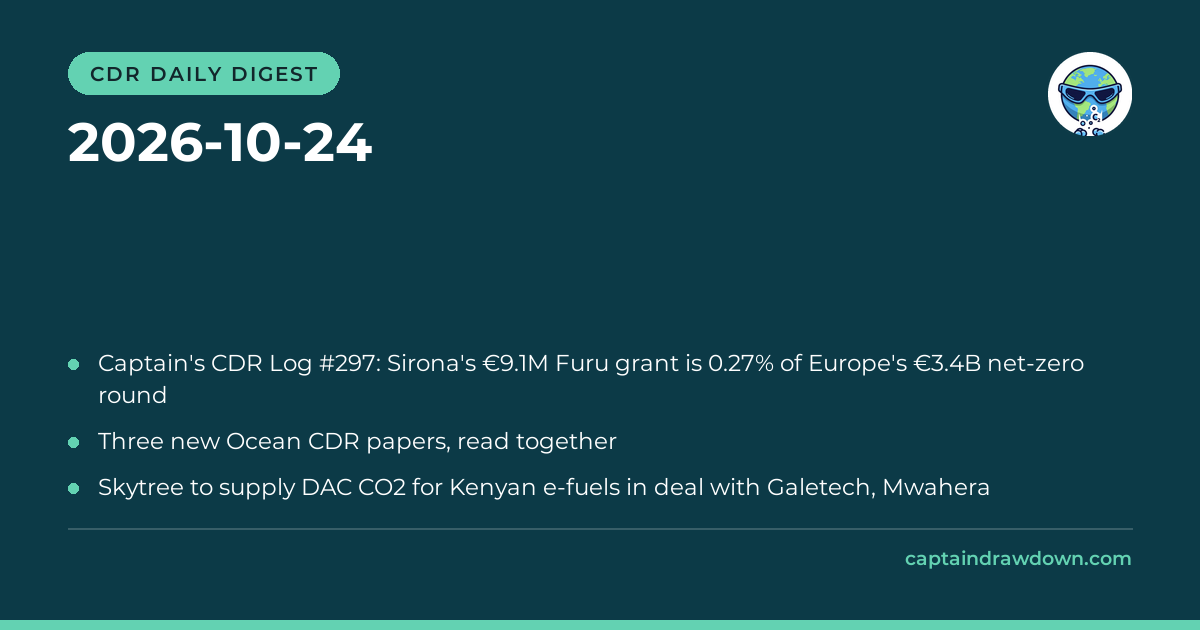
Nine million euros is 0.27% of 3.4 billion. That ratio is today’s story, and it shows up in all three posts in different clothes: CDR is still a small passenger inside much larger climate systems, whether the system is European public finance, a Kenyan e-fuels plant, or the ocean science literature.
DAC money is a rounding error inside Europe’s net-zero spending
Sirona Technologies, the Belgian DAC developer, landed a €9.1M Furu grant. Set against the €3.4B net-zero funding round it came out of, that is 0.27% of the money. I tracked the figure in Captain Drawdown’s daily CDR Log #297 because the denominator matters more than the numerator. A single DAC grant looks large on a company press release and small on a continental budget, and both views are correct at the same time.
The grant covers one company and one project. The data in the funding round does not tell me how much of the remaining 99.7% went to other removal pathways versus emissions reduction, grid, hydrogen, or industrial decarbonisation. So I cannot say whether DAC is under-funded relative to its planned role, only that it is a thin slice of what Europe is currently paying for. For a technology that the net-zero models lean on for hard-to-abate residual emissions, a thin slice is the number to watch. And it is the number I will keep tracking.
Skytree’s Kenya deal sends DAC carbon into fuel, not into the ground
Skytree, the Dutch DAC company, will supply captured CO2 to a Kenyan e-fuels project developed with Galetech and Mwahera. E-fuels are synthetic liquid fuels made by combining captured CO2 with hydrogen produced from renewable electricity. Kenya’s grid is heavy in geothermal and other low-carbon power, which is why an e-fuels developer would pick it.
This is a DAC deal, but it is not a carbon removal deal, and the distinction is worth stating plainly. CO2 that goes into a fuel comes back out of a tailpipe or an engine exhaust when the fuel burns. The climate benefit is displacing fossil carbon, not removing carbon from the atmosphere. That is useful work, and it builds the same capture hardware, supply chains, and operating experience that storage-based DAC will need later. But none of it counts as a tonne removed.
The deal shows how DAC companies are financing their first units: by selling the molecule to a customer who needs it today rather than waiting for a removal market that pays for permanent storage. The source does not disclose the CO2 volume, the price per tonne, or the timeline, so I cannot size the contract. It is a demand signal from an adjacent industry, not a removal purchase.
Three ocean CDR papers say more together than apart
Three new papers on ocean-based carbon removal came out this week, and the post reads them as a set rather than one at a time. Ocean pathways include ocean alkalinity enhancement (OAE), which adds minerals to seawater so it absorbs more CO2, and direct ocean capture (DOC), which pulls CO2 out of seawater directly. Both sit at a low technology readiness level (TRL), meaning they are closer to pilot than to commercial scale.
The reason to read the papers together is that each one addresses a different link in the same chain: what happens to the added alkalinity or the removed carbon, how long it stays out of the atmosphere, and how anyone would measure that. Measurement, reporting, and verification (MRV) is the open problem in ocean CDR, because the ocean mixes, moves, and hides the signal across thousands of kilometres and decades. No single paper closes that gap. Read as a set, they narrow it a little and name what is still unknown.
I will not overstate the result. These are papers, not deployments, and ocean CDR has no verified tonnes at scale to report. But the science is moving in the direction the market will need, which is toward MRV that a buyer could trust.
The pattern: CDR is riding inside other people’s systems
Sirona’s grant lives inside a net-zero budget mostly spent elsewhere. Skytree’s CO2 lives inside a fuel product that re-emits it. Ocean CDR lives inside an ocean science literature still working out how to count. In each case the removal part is real but small, and it depends on a larger system that was not built for it.
That is not a failure. Early industries usually grow as a side effect of something bigger before they stand alone. It does mean readers should discount headlines that call a DAC fuel contract or a research grant a “removal” milestone. Removal means permanent storage and a verified tonne count. Today’s three stories deliver neither, and all three are still worth following.
What’s next
Watch for Skytree, Galetech, or Mwahera to disclose a CO2 volume and a start date for the Kenyan plant. Until a tonnage number appears, the deal is a letter of intent in effect, whatever its legal form.
Watch the next round of European net-zero funding for the DAC share. If it stays near 0.3% while the models assume gigatonnes of DAC by mid-century, someone is going to have to explain where the money comes from. That gap is the question I would put to any policymaker who cites DAC in a net-zero plan.